Change is a necessary way of life in organization. Most organizations today are faced with tremendous forces for change stemming from different source
Change is a necessary way of life in organization. Most organizations today are faced with tremendous forces for change stemming from different source. A systematic and planned way of managing change successfully has become a primary responsibility of management, in this context; discuss the different approaches that you would recommend for managing organizational change.
How to manage any change in organization is difficult process. When organization makes any components, resistance from employee’s side comes up. To make the change successful, organization should manage it. There are different approaches to managing organizational change. On this manner we consider the following models.
- Kurt Lewin model: Kurt Lewin argued that successful change in organization should follow three steps. They are:
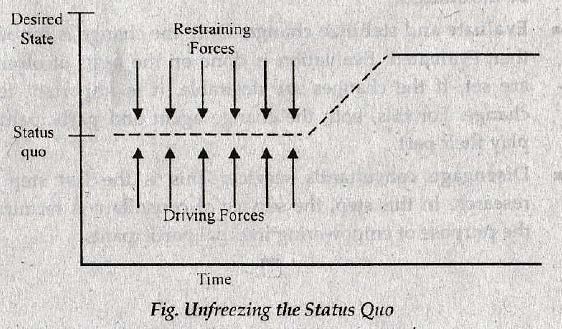
- Unfreezing the status quo: Unfreezing means the change efforts to overcome the presence of both individual resistance and group conformity. The status quo can be considered as the equilibrium state. Any employee who achieve the high status stick to it. He does not want to move from it. So, if any change organization wants to implement then employee resists that change due to the status quo. So, to implement the change successfully, organization unfreezes the status quo of the employee. This can be done through following ways:
- Driving forces,
- Restraining forces and
- Combination of both
The Driving force is that force which directs the behaviours of the employee from the status quo.
The Restraining is that force which hinders the movement from the status quo, changing behaviour of employee through increasing their pay, if they accept the change,
b. Movement to a new status: Only unfreezing the status quo is not sufficient to manage the change. Now the employee who has changed their behaviour from status quo should be moved to new state to make the change stable. If they are not moved to the new state, they might freeze to the status quo. Thus movement to the new state is another step to make the organizational change successful.
c. Refreezing the new change: Once the employee is moved to the new state, they should be retained in the new status, otherwise they may comeback to the previous state and the change may not be successful. Thus, to retain them in the new state is very much essential to make change successful. To Retain/Refreeze in the new state, temporary force should be systematically replaced with permanent ones. This build up confidence in employee towards organization and will be socialize in the new environment. In this way, the change can be made successful in the organization.
2. Action research: Action research is concerned with practical problems with theoretical relevance and has three masters-the sponsors, the behavioural science, practitioner and the scientific community. Action research is a data drawn problem solving model of organization change. The key steps of action research model are enlisted as follows:
- Establish client consultant relationship: One should establish client-consultant In doing so, one must determine three major components.
- Clients readiness for change
- Consultant’s power base
- Consultant’s role in relationship
- Diagnose the need for change: In the second step, action research diagnoses the need for change. In this regard, it goes through a systematic analysis of the situation.
- Introduce change: It is the most critical step in action research. In this step, the concerned parties decide the type of change to be introduced.
- Evaluate and stabilize change: Once the change is introduced it is then Evaluation is done on the basis of objectives that are set. If the changes are desirable, it is important to stabilize change. For this, both the change agent and participants need to play their part.
- Disengage consultant’s service: This is the last step in action research. In this step, the service of consultant is terminated with the purpose of empowering internal participants.